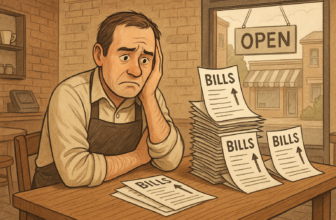
The Silent Recession: How Small Businesses Are Bearing the Cost of Every ‘Tech Update’
You open your email Monday morning, and there it is again: another notification telling you that your point-of-sale software requires an immediate update. The message is friendly enough, promising “enhanced features” and “improved security,” but you know what’s really coming—another hit to your already stretched budget.
While tech companies celebrate their innovation cycles, small businesses are quietly drowning under the weight of relentless upgrade demands. What looks like progress on the surface is actually creating a silent financial burden that threatens the sustainability of businesses operating on thin margins.
The Endless Update Cycle
The pace of software and hardware updates has become exhausting. What used to be annual upgrades now happen quarterly, monthly, or even weekly. Your business faces a constant barrage of notifications for:
- Operating system upgrades that promise better performance
- POS system updates with new compliance requirements
- Security software renewals at steadily increasing prices
- Cloud storage subscription increases that arrive without warning
Here’s the real problem: this isn’t just about keeping current. It’s about forced obsolescence. Tech companies deliberately phase out support for older systems, making them incompatible with newer software.
When your accounting program updates, suddenly your three-year-old computer can’t run it. When your payment processor upgrades, your perfectly functional POS terminal becomes worthless.
According to recent research, small businesses spend between $1,000 to $3,400 monthly on IT support alone. Meanwhile, large enterprises can negotiate better rates and spread costs across bigger operations. You’re paying premium prices for the same technology that corporations buy in bulk.
The Hidden Costs Beyond the Price Tag
The sticker price is just the beginning. Every update creates a ripple effect of expenses that eat into your bottom line.
Direct costs that hit immediately
Direct costs show up first and are the easiest to see:
- Subscription fees that quietly increase by 10–15% annually
- Payment processors that start at $49 per month and creep up to $79 while you’re locked into a contract
- Hardware replacements when new software demands more processing power or memory
- Licensing fees and migration costs that add hundreds or thousands of dollars
Indirect costs that hurt your operations
But the indirect costs often hurt even worse.
I remember when our office updated our CRM system—what should have been a simple overnight installation turned into three days of chaos. Employee training consumed 12 hours of productive work time. The system went down twice during our busiest sales period. We lost data during migration that took weeks to reconstruct.
Industry data shows that downtime costs small businesses over $300,000 annually when you factor in lost productivity and revenue. For businesses operating on 5–10% profit margins, that’s devastating.
The compatibility trap
There’s also the compatibility trap—one update triggers a cascade of others.
A small retail shop in Oregon discovered this the hard way when their payment processor stopped supporting their POS system. The “simple” terminal replacement required:
- New networking equipment
- Updated accounting software
- A complete retraining of their staff
Total cost: $8,500 for something that wasn’t broken in the first place.
Why Small Businesses Are Disproportionately Affected
You don’t have the luxury of an IT department to manage these transitions. While corporations employ dedicated teams to plan upgrades, you’re handling it between serving customers and managing payroll.
Your negotiating power is essentially zero. Enterprise clients get volume discounts, extended payment terms, and dedicated support. You get take-it-or-leave-it pricing and automated chatbot help that rarely solves actual problems.
The margins make everything worse. When tech costs increase by $500 monthly, a large corporation barely notices. For you, that’s the equivalent of several employees’ wages or rent for your storage space.
You can’t delay updates either—that risks security vulnerabilities and compliance violations. The choice often feels like:
- Pay more than you can afford to stay current, or
- Fall behind and risk fines, breaches, or system failures
The disconnect is real: enterprise-focused solutions are marketed to small businesses as if your needs and resources are identical. They’re not.
Finding Balance: What Can Be Done
You need a strategy, not just reactive spending.
- Build tech update costs into your annual budget as a fixed percentage of revenue—typically 3–5%, depending on how tech-heavy your operations are.
- Explore open-source alternatives for non-critical functions. They often provide comparable features without subscription traps or aggressive upgrade cycles.
- Look for providers with small-business-specific solutions and transparent pricing. Some vendors now offer:
- Longer support cycles for software and hardware
- Clearly stated pricing tiers and timelines for increases
- Lightweight tools that don’t require constant hardware refreshes
For example, resources like this guide to invoice software for small businesses can help you compare options built with smaller operations in mind.
Beyond individual choices, the industry itself needs fundamental change:
- More transparent pricing models
- Longer support windows for existing systems
- Recognition that constant upgrades are not always necessary or beneficial
The Path Forward
Small businesses shouldn’t have to choose between staying technologically current and staying profitable. Innovation is valuable, but not when it extracts unsustainable costs from the backbone of our economy.
We need greater awareness of this burden and advocacy for fairer tech pricing structures. Your business deserves technology solutions that support growth, not systems that quietly drain resources through endless update cycles.
The tech ecosystem must become more equitable—or risk losing the very businesses it claims to serve.

Are you a U.S. company looking to expand your talent
Read more

Small Business Expense Tracking: A Simple Guide to Manage Your
Read more

Do you wish to find the leading EOR service providers
Read more

Picture this: It's 11 PM on Sunday night, and you're
Read more